Building Engaging, Scalable Gamification Experiences for Amazon India
Our gamification initiative aimed to create a space within the Amazon India shopping app for engaging customers while supporting Amazon’s inventory and sales metrics. These games, hosted under the Funzone platform, included formats like _Spin and Win_, quizzes, and skill-based riddles. By attracting over 15.4 million unique users during the festive season, Funzone demonstrated the high impact gamification could have on engagement, brand loyalty, and business outcomes.
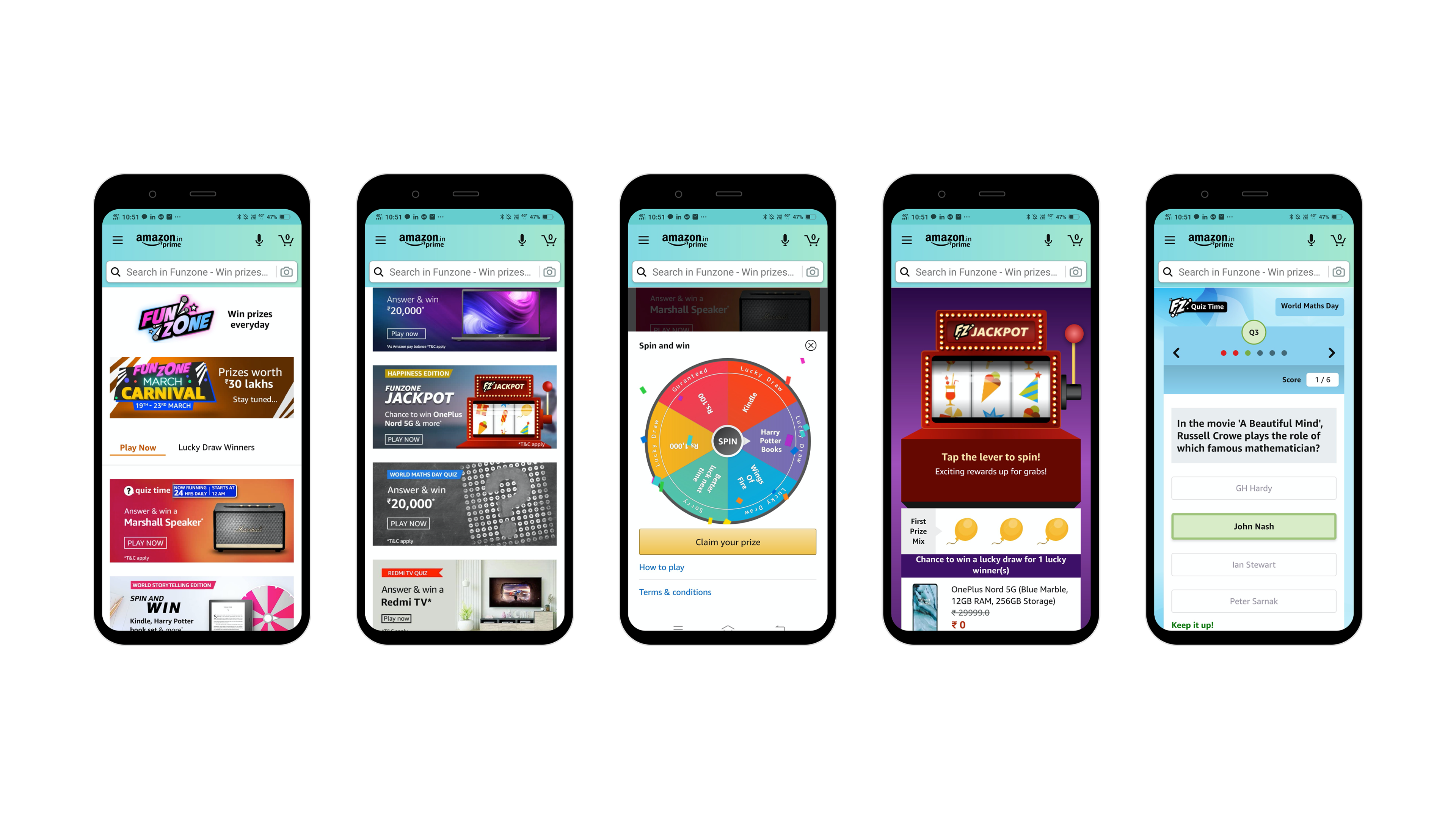
Overview
As the UX strategist behind Amazon India's gamification program, my role was to craft user-centered, engaging game experiences that reinforced Amazon's broader shopping ecosystem. This was not a straightforward design task—Funzone, Amazon's gamification platform, needed to bridge e-commerce objectives with entertaining game features without losing sight of usability and simplicity for millions of diverse customers. My approach was rooted in strategically shaping experiences that would be compelling, functional, and repeatable on a large scale, even as we integrated intricate back-end functionalities and expanded cross-platform consistency.
My Role: Leading with Strategic UX
In my role, I was responsible for establishing a cohesive UX strategy and managing the ongoing integration of new game experiences, all while coordinating closely with engineering, product, and regional teams. My main contributions included:
-
Building a Scalable UX Framework
To support the program’s rapid growth, I created UX principles that addressed the nuances of game mechanics, rewards, and customer interactions. These principles informed standard UI components, such as prize claim flows and access points, which could be adapted for any game type.
-
UX Guidelines for Repeatable Success
By standardizing visual and interaction patterns, I enabled a cohesive user experience that supported both skill-based and chance-based games. These guidelines also influenced stakeholders globally, encouraging other teams to integrate gamified elements seamlessly into their regional Amazon platforms.
-
Cross-Functional Collaboration
Working with global teams, I orchestrated UX guidelines that streamlined communications with engineering, reducing back-and-forths on design simulations by building directly into the front-end. This proactive engagement was essential in creating a consistent experience without overwhelming users.
-
Building a Reusable Design Library
I developed a component library, empowering designers and engineers to reduce build times and maintain UX consistency across releases. As a gatekeeper, I reviewed new game ideas, ensuring they aligned with the strategic goals of integrating engagement with shopping flows.
-
UX Insights for Business Impact
By reviewing and refining visual design, I also contributed to enhancing ad performance within gamified interfaces, proving the role of UX in driving measurable outcomes. The data showed that Funzone drove significant additional DSI-OPS (Days Sales Inventory Operating Profit), establishing gamification as a strategic pillar in customer engagement for Amazon IN.
Challenge
Creating user-centric gamification experiences that were accessible and highly engaging required navigating a complex web of challenges:
-
Scalable UX Consistency
Games needed a uniform, intuitive prize claim flow that was scalable across different formats.
-
Integration of Rewards
Rewards varied from direct cashbacks to items that incentivized further shopping. Ensuring seamless delivery and integration of these rewards was a primary focus.
-
Rapid Iteration
For a high-traffic, high-visibility program like this, design cycles had to keep pace with seasonal campaigns while maintaining Amazon’s high-quality standards.
Strategic Approach
Taking a strategic approach, I viewed these complexities as opportunities to simplify and enrich the user journey. I focused on building an engaging, repeatable framework grounded in robust gamification UX strategies that transcended individual games. Diving deep into game mechanics and reward structures, I established a cohesive user experience model that ensured consistent UI and reward flows across diverse game scenarios. This unified structure allowed for scalable expansion across Amazon’s ecosystem, eliminating design silos and enhancing customer engagement with a streamlined yet impactful UX. The result was not only an increase in customer enjoyment but also a more viable, scalable initiative with far-reaching potential within Amazon’s marketplace.
Results: Establishing Funzone as a Scalable Gamification Platform
The program’s impact exceeded expectations, with Spin and Win, quizzes, and other games ranking among Amazon IN's top high-value actions (HVAs). The data reinforced the business impact of an engaging UX: customers’ first quiz participation alone contributed an additional INR 2242 in DSI-OPS over 365 days, comparable to other high-impact categories like wireless devices. The Funzone platform’s success led to an ongoing expansion across Amazon’s product lines and international markets. As the platform evolved, the reusable component library I developed played a key role in shortening the launch time for new game experiences, driving operational efficiency, and supporting Amazon’s objectives of daily customer engagement.
Reflections: Transforming Complexity into Strategic UX
Working on Amazon's gamification program sharpened my ability to create value amidst complexity. The multi-layered process of designing for Funzone, collaborating across diverse teams, and building a standardized experience taught me the importance of establishing user-centric tenets in high-stakes environments. By focusing on what would deliver the most seamless experience for users and embedding this focus within technical and operational processes, I was able to bring a strategic UX perspective to Amazon's unique advertising and e-commerce ecosystem.
This project reinforced my conviction in the power of UX strategy and operational collaboration, underscoring that with the right design framework, even the most complex challenges can be made engaging, accessible, and impactful.